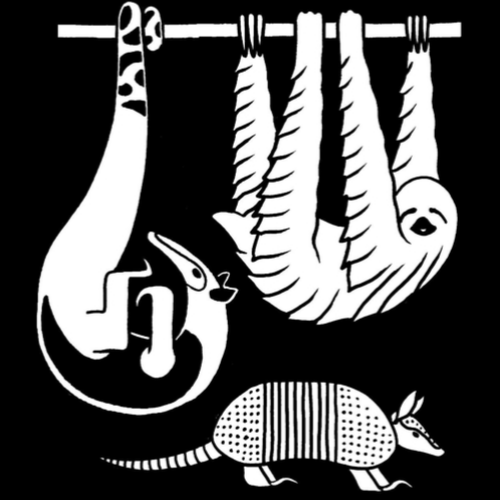
Northern long-nosed armadillo
(Dasypus sabanicola)
other common names
Llanos long-nosed armadillo
Taxonomy
Order: Cingulata
Family: Dasypodidae
Subfamily: Dasypodinae

description
This is a relatively small long-nosed armadillo species. It has a head-body length of 25–31 cm, 8 movable bands, and a relatively long tail, of 17–21 cm. Its weight is 1–2 kg. It can be difficult to distinguish D. sabanicola from juvenile D. novemcinctus. Northern long-nosed armadillos have a shorter snout than D. novemcinctus and a more uniform grey carapace color.

diet
This species feeds primarily on termites, but it also eats ants, beetles, and worms.

reproduction
Breeding occurs from October through March. Implantation of the fertilized egg is delayed by 2–4 months to ensure the offspring are born during a period of the year when sufficient food is available for the lactating females. Gestation probably starts in April or May and lasts until August of September, when females give birth to four monozygotic (genetically identical) offspring per litter. No data are available on the age at first reproduction or longevity of D. sabanicola.

range
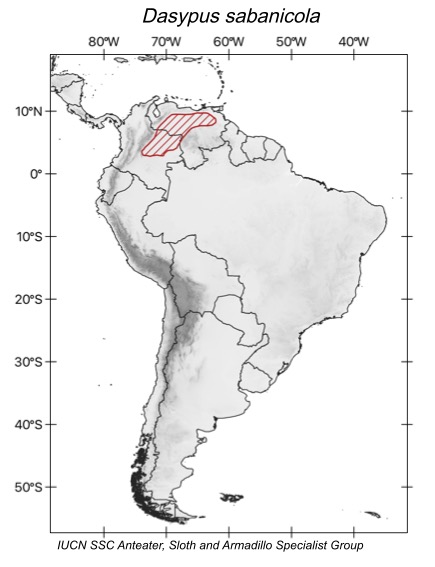
Dasypus sabanicola is found throughout the Llanos (flat plains) of Venezuela and Colombia.

Population trend
Decreasing.

curious facts
Lactating females may accumulate plant matter at the entrance of their burrows, where they leave their offspring while they search for food. This plant material also protects the burrows from flooding during the rainy season.

threats
This species is threatened by intense (subsistence) hunting in Venezuela. It is the armadillo species that is most sought after by hunters in the llanos of Colombia. In addition, the species is affected by land conversion for agro-industry farming (mainly rice, soy and corn), timber plantations, and palm oil plantations.
Estimates from the Orinoquia region of Colombia suggest that approximately 10% of the natural habitat of this species is subjected to land use change every year. Over the last decade, the area with rice crops increased in 134.93%. Additionally, the human footprint in the region has grown by 35% and is projected to increase by 6% in the next decade. About 45% of the total area of the Orinoquia (approximately 150,000 km²) has been classified as suitable for agricultural development. The area used for oil palm, rice, timber, soy, and corn plantations in the Orinoquia region is projected to increase more than ten-fold over the next decade, especially due to a significant increase in biofuel and timber production, which calls for an urgent assessment of the potential effects on the D. sabanicola population. Although the tolerance of this small armadillo to modified habitats has not been studied to date, reports from locals suggest that it does survive in areas with extensive cattle ranching, and that subpopulations have declined or even disappeared from cultivated areas. It is probable that the species cannot survive in cultivated areas in which agrochemicals are used for insect control, as they severely reduce the availability of the main food source of D. sabanicola.

HaBITAT and ECOLOGy
Dasypus sabanicola inhabits the llanos of Colombia and Venezuela; it can be found in open grasslands or shrubland habitats in lowland and mid-altitude areas. This species may have diurnal or nocturnal habits. Animals have a home range of between 1.7 and 11.6 hectares, and the average density in Venezuela has been estimated at 2.8 animals per hectare. The generation length of a closely related armadillo, Dasypus septemcinctus hybridus, has been estimated to be 4 years. The generation length for D. sabanicola is suspected to be similar.

conservation status
Dasypus sabanicola is restricted to the floodplains (llanos) of Colombia and Venezuela. It is the armadillo species that is most sought after by hunters in the llanos of Colombia and is affected by habitat loss due to land conversion for biofuel production, timber plantations, and agro-industry farming. In Colombia, about 10% of its natural habitat are subjected to land use change every year, and this impact is expected to increase over the next decade. In addition, agrochemicals used for insect control is severely reducing the availability of the main food source of D. sabanicola, thus further affecting the species.
The factors affecting the Northern Long-nosed Armadillo warrant a precautionary assessment of Near Threatened, as it almost qualifies for listing under criterion A4cd. A population reduction of at least 25% is suspected due to declines in habitat quality and quantity, as well as due to estimated levels of exploitation, over three generations (suspected to be around 12 years), taking into account a time window of 8 years in the past and 4 years in the future.